
Airbnb Alternative in Kathmandu: Why Direct-Booking Apartments Beat Hotels and Booking.com (2026)
Looking for an Airbnb alternative in Kathmandu? Smart-lock self check-in, WhatsApp host, no platform fees. The honest 2026 direct-booking playbook.
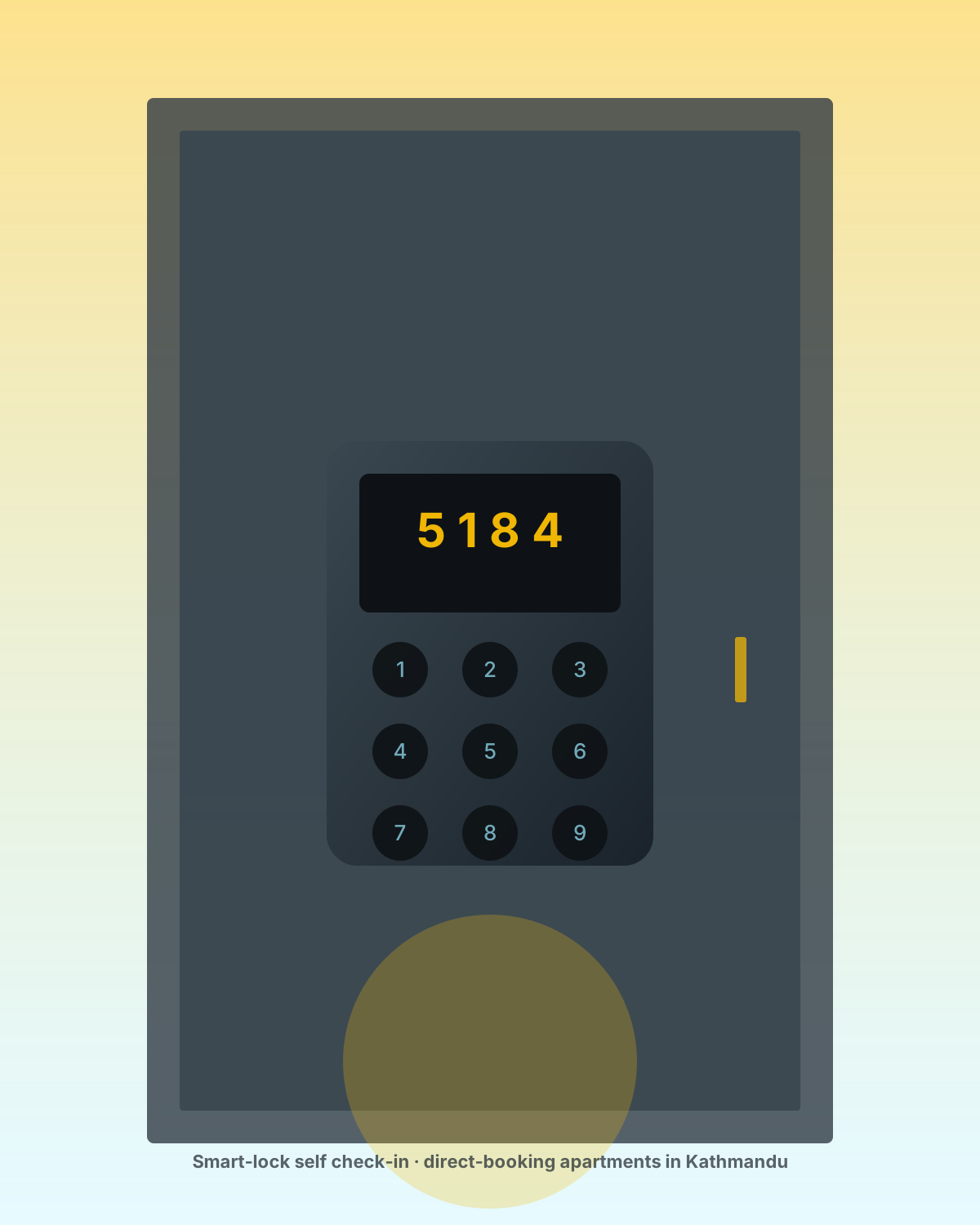
Picture the typical Kathmandu arrival a decade ago. You stumble out of Tribhuvan International Airport at 2 AM, jet-lagged and stiff from a 14-hour layover. The taxi driver weaves through quiet, dimly lit streets to your guesthouse in Thamel. The front desk is locked. You ring a bell. After ten minutes a sleepy night manager appears, fumbles with a register, hands you a brass key, and shows you to your room.
That arrival was — depending on your nerves — either romantic or absolutely brutal.
It is also, increasingly, a relic. Over the last three years a quiet revolution has reshaped how travellers actually enter their accommodation in Kathmandu: the smart lock and the direct-booking apartment. And it has quietly turned the city into one of the best places in Asia to skip the platforms entirely and book the best Airbnb alternative in Kathmandu — your accommodation operator's own website.
Airbnb vs Booking.com vs direct booking in Kathmandu (2026)
If you want the short version, the table below sums up the differences travellers actually feel on the ground in Kathmandu. The detailed reasoning is in the rest of the article.
| Airbnb | Booking.com | Direct booking (Tiny Living) | |
|---|---|---|---|
| Platform service fee | 14–16% blended (host + guest) | ~15% commission baked into nightly rate | 0% — guest pays the rate, full stop |
| Cancellation | Help-centre ticket, 2–3 weeks to resolve | Strict-flex per listing | Direct host, decided in 5 minutes over WhatsApp |
| Check-in | Often meet-and-greet | Lobby check-in, 14:00 onwards | Self check-in any time after 15:00 via smart-lock keypad |
| Communication | In-app messages (filtered, no phone, no links) | Booking inbox | Direct WhatsApp to a local host, replies in minutes |
| Door code security | Often a shared master key | Mechanical key from reception | Re-issued for every stay, master code rotated monthly |
| Payment methods | Card only | Card only | Stripe (Visa, Mastercard, Amex, Apple Pay, Google Pay, PayPal) or direct bank transfer for guests in Nepal |
| Long-stay discount | Up to 15% if host configures | Limited | 5% weekly, 15% monthly built into the cart |
| Airport pickup | Almost never | Sometimes paid extra | Optional add-on at booking, normal taxi or luxury car |
| Refund speed | Routed through Airbnb support | Routed through Booking support | Direct from the host, same day |
If you only read one section: the platform fee is the obvious win, but the smart-lock + WhatsApp combination is what actually changes the arrival experience. Browse our Kathmandu serviced apartments to see what the direct-booking version looks like.
Why the old way persisted for so long
For most of Nepal's modern tourism history, three forces kept the lobby-and-key model alive:
- Tour operator workflows. Big trekking companies blocked rooms by the dozen and needed a fixed handover desk. That meant a 24-hour reception at every "tourist standard" hotel.
- Trust at the door. ID verification, refundable deposits, and the awkward "would you like to see the room first?" walkthrough all happened face-to-face.
- Tech reality. Reliable mobile internet, Bluetooth locks, and online payment infrastructure were spotty until about 2021. Self check-in genuinely was not possible at scale.
All three of those conditions have changed. Smart locks dropped 80% in price. Pathao and inDriver mean you can reach any address at any hour. And Nepali banks finally let merchants charge international cards. The lobby-and-key model wasn't replaced by a single competitor — it was replaced by a whole new operating pattern.
The new pattern: direct booking + smart-lock self check-in
Walk through what an arrival looks like today at a Tiny Living apartment:
1. You book on the operator's own website (no platform middleman). See how booking works for the full step-by-step. 2. The day before arrival, you get a WhatsApp message with the exact street address, the door code, and a 30-second video walking you to the entrance. 3. You land. Your taxi pulls up. You enter the door code on a backlit keypad. The door unlocks. You're in.
No lobby. No clipboard. No sleepy night manager. The entire arrival is silent, dignified, and respectful of how exhausted you actually are after that 14-hour layover. The full mechanics of the smart lock — what happens if the code fails, how the code is reset, who has the master — are documented in our door locks and self check-in guide.
Why direct booking in Kathmandu beats Airbnb and Booking.com
Once self check-in solved the operational problem, the booking question reopened. If a guest is going to arrive without ever meeting a human, do we really need Airbnb or Booking.com to be the middleman?
The numbers say no. Here is what direct booking changes:
1. You keep 10 – 20% that would otherwise vanish
Airbnb and Booking.com take a service fee on every transaction — typically 14 to 16% blended across the host and guest sides. For a 7-night stay at $80 / night that is roughly $80 of pure friction. The direct-booking operator can charge the same nightly rate and the guest keeps the savings, or split the difference, or roll it into a better cleaning kit, fresh towels and an upgraded coffee setup.
If you want the broader maths on what a week in Kathmandu actually costs you, see our cost of living in Kathmandu 2026 guide.
2. The conversation is direct, fast and uncensored
On the big platforms every message is filtered through the platform's anti-circumvention system. You cannot get a phone number, you cannot share an external link, you cannot easily ask "is there a backup generator?" without setting off a flag. On WhatsApp with a direct operator, the questions land in 30 seconds and the answers come from a real human who actually owns the place.
3. Cancellation, refunds and emergencies are sane
Hotels treat cancellations as a contract negotiation. Airbnb treats them as a help-centre ticket that resolves three weeks later. Direct operators can decide, in writing, on the spot. Visa denied at the embassy? Force majeure? Sister wedding bumped a week? A direct host can refund in five minutes; a platform host still has to escalate through customer service. The full direct-booking refund terms are spelled out in our refund policy.
4. The smart lock is genuinely yours
When you book direct you get a code that belongs to you and your booking — not a master key that 200 other guests have used. We re-issue the code for every stay. We rotate the master code monthly. The platform-based equivalent often shares a single mechanical key across every guest who passed through that month.
What about Airbnb's "verified" assurances?
Airbnb's host verification, the protection programs and the dispute mediation are real benefits — for first-time bookers. The catch is that those programs are mostly insurance against rare downside risk, paid for with a permanent platform fee. After your first or second successful stay with a direct operator, the marginal value of those programs collapses.
A reasonable compromise we see emerging: book your first stay via Airbnb, then rebook the same place direct for every subsequent visit. You get to use Airbnb as a trust-building introduction service, then switch off the meter once you know the operator.
The honest downsides of direct booking
In the spirit of being lived-in, here is what direct still does not do as well as the big platforms:
- Search. Airbnb's discovery engine is genuinely useful when you have no idea what you want. A direct operator's website only ever shows their own apartments.
- Aggregated reviews. A 4.9★ from 400 stays is harder to argue with than a 5★ from 12 stays. We publish our Airbnb-side reviews on our own listing pages now, but the platform total is still the gold standard for social proof.
- Local laws and consumer protection. Some jurisdictions require platforms to refund certain cancellations. Direct bookings rely on operator goodwill plus your card chargeback rights.
What to actually do on your next Kathmandu trip
If this is your first Nepal trip and you have never met the operator before, the safest play is to book through Airbnb for the first stay. Use the reservation to verify the apartment is real, the host responds to messages, and the door code arrives on time.
After that, message us on WhatsApp and book direct for every return visit. We pass the platform savings back in two ways: a 10% direct-booking discount in the cart, and longer-stay tiers (5% weekly, 15% monthly) that the platforms cannot match because their fee model is volume-based.
Self check-in did not just change how doors unlock. It quietly rewired the entire booking economics of short-stay travel in Kathmandu, and direct operators are now the cleanest expression of that shift. The lobby is dead. Long live the keypad.
FAQ: Airbnb alternatives and direct booking in Kathmandu
What is the best Airbnb alternative in Kathmandu in 2026?
For short-term serviced apartments in central Kathmandu, the leading direct-booking alternatives are operator websites that handle smart-lock self check-in, WhatsApp support and instant confirmation without the 14–16% platform fee. Tiny Living Apartments is one of them — apartments in Thamel, Lazimpat, Putalisadak, Patan and Boudhanath, all bookable direct.
Is direct booking cheaper than Airbnb in Nepal?
Yes, typically by 10–20%. Airbnb and Booking.com take a 14–16% blended service fee on every booking. Direct operators charge the same nightly rate without the fee, so a 7-night stay at $80/night saves you roughly $80–$90. Long stays compound the saving — monthly bookings can save the equivalent of a visa extension plus a week of food.
How do I check in to a Kathmandu apartment without meeting the host?
With a smart-lock keypad. The day before arrival you get a WhatsApp message with the street address, a unique door code for your stay, and a 30-second video walking you from the main road to the door. You enter the code on the keypad, the door unlocks, you're in. No lobby, no clipboard. See our door locks and self check-in guide for the full walk-through.
Can I get a refund if I book direct in Nepal?
Yes. Direct hosts can issue refunds on the spot via WhatsApp — usually within five minutes, with the money landing back on your card in 5–10 business days. There is no help-centre ticket and no two-week mediation. The cancellation tiers are spelled out clearly in our refund policy.
How do I pay for a direct-booking apartment in Kathmandu?
Two options. Stripe (Visa, Mastercard, Amex, Apple Pay, Google Pay or PayPal) gives you instant confirmation and is the right choice for international travellers. Direct bank transfer to a Nepali bank account is available for guests already in Nepal — confirmation lands once the deposit clears. The full payment walkthrough is in our booking process.
What if my flight lands at 2 AM?
Self check-in is the whole point. The door code works 24/7. There is no reception to wait up for and no late-arrival fee. If you want a pre-booked airport pickup we can also arrange a normal taxi or a luxury car at booking.
Are direct-booking apartments in Kathmandu safe for solo female travellers?
Yes — and the smart-lock arrival is often safer than the lobby model because there is no clipboard register and no late-night receptionist who can clock that you are travelling alone. We cover the full picture in Is Nepal safe for solo female travellers? A 2026 guide.
Next steps
- Browse our Kathmandu serviced apartments — direct booking, no platform fees.
- See how booking works end-to-end.
- Compare Thamel vs Patan before you pick a neighbourhood.
- Get your Nepal eSIM sorted before you land.
- Plan the budget with our cost of living in Kathmandu 2026 guide.
<!-- tla:related-reading -->