
Tiny Living journal
Beyond the Teahouse: Why a Community Homestay in Nepal Will Ruin Regular Hotels for You
Swap your hotel keycard for a family home. A lived-in tour of the Community Homestay Network — Panauti tika welcomes, Kirtipur momo-folding, Barauli mud kitchens, Patlekhet leaf-plate weddings — and how 80% of your booking fee fuels women-led independence across rural Nepal.
When most people plan a trip to Nepal, their minds drift to a very specific set of postcards. They picture themselves standing beneath the icy, towering peaks of Mount Everest or the Annapurnas, huddling around a metal stove in a drafty high-altitude teahouse, or dodging rickshaws in the neon-lit, chaotic maze of Thamel.
But there is another side of Nepal — one that exists far from the major trekking routes and commercial tourist corridors. It is a world of terraced emerald rice paddies, quiet historic brick alleys, and kitchens where the cooking is done over open flames.
For years, travellers who wanted to connect deeply with this side of Nepal had to rely on sheer luck or navigate difficult language barriers on their own. But over the last decade, a quiet, women-led revolution has completely transformed how people experience the country.
This is the Community Homestay Network (CHN). What began in 2012 with a single pioneering home in the medieval town of Panauti has grown into an internationally acclaimed social enterprise connecting travellers with more than 380 households across 50 distinct communities. In fact, it was recently honoured in TIME Magazine's prestigious list of the World's Greatest Places.
If you want to experience the true heartbeat of Nepal, swap your hotel keycard for a family home. Having spent time living, cooking, and laughing across language barriers in these communities, here is an insider's look at why a community homestay is the most meaningful choice you can make on your Nepalese adventure.
1. The Soul of the Network: Panauti's Pioneering Women
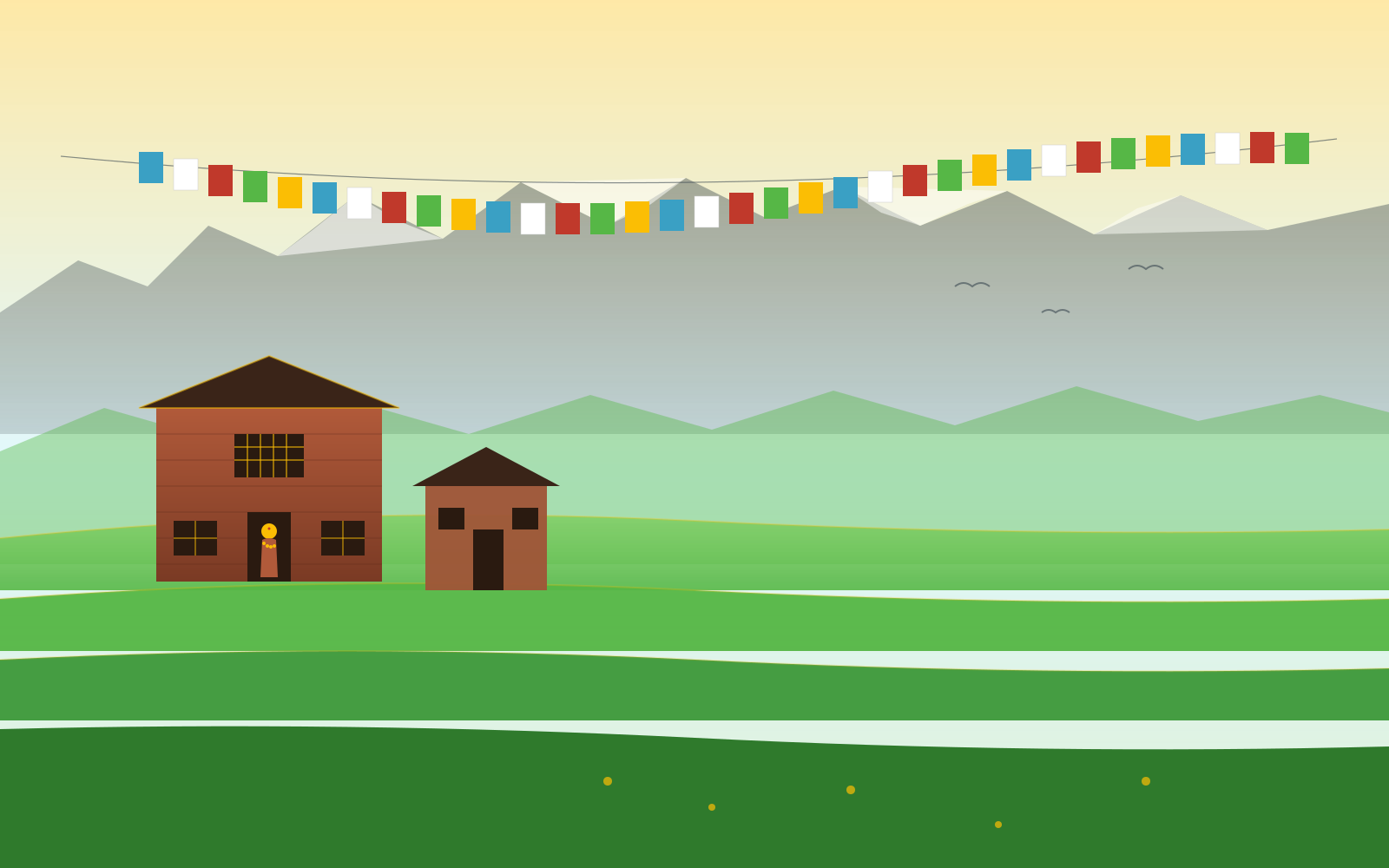
About 34 kilometres southeast of Kathmandu lies Panauti, a beautiful, red-brick medieval town that feels like a place where time decided to stand still. Tucked away between luminous farmland and ancient 13th-century Newari temples, Panauti was the very first destination in the Community Homestay Network — and the welcome ritual sets the tone for everything that follows: a quiet arrival in the old town, a hand-woven marigold mala draped over your shoulders, and a red tika pressed onto your forehead to honour your journey.
When you arrive at a homestay in Panauti, you are not handed a registration form. Instead, you are welcomed at the door by a host like Mina Koirala — a warm, quick-witted grandmother who has found complete financial independence and a proud voice through this project. Mina will press a cool, damp red tika onto your forehead and drape a handmade marigold flower necklace (mala) around your neck.
"I didn't want to have to ask anyone for money; I wanted to be independent," Mina says when she talks about the impact of the network.
The beauty of these stays is how quickly the boundary between "guest" and "family" disappears. In the home of another host, Biju, and her daughters Nirusha and Aayusha, you are led up three steep flights of stairs to the kitchen. In Newari tradition, the kitchen is kept on the top floor of the house to escape the dust of the street below.
Before you step onto the clean kitchen floor, there is a simple, beautiful ritual: you drink a small sip of water poured directly into your hand to show that your hands are clean and ready to share a meal.
Sitting on the floor, Biju will serve you a plate of the most incredible, fresh, homemade dal bhat you will ever taste — featuring hand-dried mountain spices, fresh lentils, and organic vegetables pulled straight from the family's fields.
By the time dinner is finished and you are enjoying a tiny glass of homemade rice wine (raksi), Biju will look at you with a smile and call you her "Nepali chhori" (daughter) or "Nepali babu" (son). You aren't just checking out of a hotel; you are leaving family behind.
2. Kirtipur: Clumsy Momo-Folding and Sacred Temples
Perched on a double-hilled ridge just a short drive southwest of Kathmandu's urban center, the ancient town of Kirtipur offers a different window into Newari cultural heritage.
Here, the Community Homestay Network has partnered with organisations like Planeterra and USAID to help local women transform their daily cooking routines into incredible cultural exchanges. A typical day pairs a morning exploration through Kirtipur's steep, stone-paved galis (lanes) — taking in a dawn puja at the Bagh Bhairav temple — with an afternoon momo-making class around low kitchen tables, rolling thin wrappers and pleating spiced vegetable or buffalo dumplings under your hostess's quietly amused eye.
When you stay with a host like Ganga Hayanju, the experience is deeply collaborative.
Early in the morning, Ganga will guide you through the town's steep, stone-paved lanes to visit the historic Bagh Bhairav Temple, where local residents gather in colourful clothes to bring offerings for the Dashain festival.
But the true highlight of the stay happens back in Ganga's sunny kitchen.
Ganga runs a hands-on workshop teaching travellers the precise, delicate art of folding momo (traditional Nepalese dumplings filled with spiced meat or vegetables).
While it looks deceptively simple, achieving the perfect pleats on a thin circle of dough is a true test of manual skill.
As you struggle with clumsy fingers, Ganga will laugh, patiently correct your technique, and offer you a traditional Newari sweet to keep your energy up. It is in these simple, shared moments of laughter across a kitchen table that the true value of community tourism is felt.
3. Barauli: Wildlife, Mud Kitchens, and Escaping Goats
If you head south to the subtropical lowlands of the Terai, you enter Barauli, a tranquil village of thatched-roof cottages located right on the edge of the wild Chitwan National Park.
Barauli is home to the indigenous Tharu community, who have lived in close harmony with the surrounding jungles for generations. Expect thatched mud huts, solar-heated baths, the easy proximity of Chitwan's elephant and rhino safaris, and kitchens where you sit on low mats while playful village goats wander in and out of the doorway.
Staying here at the Barauli Community Stay offers a wonderful contrast to the mountain homestays of the Kathmandu Valley.
Your host, Jeevan Kumari, will guide you on bicycle rides through quiet dirt tracks lined with lush green rice paddies, helping you spot exotic birds and learn about Tharu history.
In the evening, you will join another local woman, Tara, in her traditional mud-floored kitchen for a cooking lesson.
Because Tharu kitchens are highly traditional, you will crouch on a woven straw mat on the floor and learn to cut potatoes, carrots, and onions using a bansi — a sharp, curved knife anchored securely to the floor by your own foot.
While you try to coordinate your hands and feet without making a mess, the kitchen door will likely remain open, allowing curious neighbourhood children — and occasionally a couple of playful little black goats — to wander in and out of the cooking area.
It is an incredibly vivid, sensory experience that is completely unscripted and full of joy.
4. Patlekhet: Organic Farms and Wedding Preparations
Further east, nestled in the quiet, rolling hills near Dhulikhel, lies Patlekhet. This is a peaceful agricultural village covered in terraced fields, organic vegetable gardens, and citrus orchards — and a day here rhythm tracks the farm clock: a 5:30 AM milking with Narayan in the mist-shrouded shed (followed by chai with the fresh milk), then an afternoon spent weaving ceremonial tapari plates out of broad green forest leaves with his sister Usha and her neighbours.
When you stay with a host family like Narayan's, you are invited to join in the active rhythm of farm life.
You can wake up early to help Narayan milk the family's cows in the cool morning air, or walk through the fields picking fresh oranges and green beans for breakfast.
If you are lucky enough to visit during a local celebration, you might even get pulled into the family's preparations.
During my stay, Narayan's sister, Usha, was getting married in ten days. The house was a hive of activity.
Neighbours from all over the village were stopping by the yard to assign cooking duties, share stories, and sit in a circle to weave traditional ceremonial serving plates (tapari) out of broad green forest leaves.
To sit alongside three generations of a family, learning to pin leaves together with tiny bamboo splints while sipping hot milk tea, is a beautiful experience. It provides a genuine, unfiltered connection to local culture that no resort or guided tour could ever replicate.
Lived-In Perspective: Choosing Your Community Stay
- Panauti — classic Newari heritage and historic temple walks, with Wi-Fi and solar-heated showers. Best suited to first-timers who want culture without sacrificing comfort.
- Kirtipur — momo-pleating workshops and Ranjana Lipi calligraphy classes, all within easy reach of the Kathmandu core. Best for travellers on a tight schedule.
- Barauli — Tharu jungle history and bicycle safaris from cosy private Tharu-style cottages. Best for wildlife lovers and active adventurers.
- Patlekhet — organic farming, cow milking and leaf-plate weaving, set in lush mountain air with hiking trails on the doorstep. Best for nature lovers and slow travellers.
The Practical Homestay Etiquette Playbook
Staying in a private family home requires a respectful, thoughtful approach to local customs. To ensure you are a wonderful guest, keep these five simple rules in mind:
- The Shoes-Off Rule: Always remove your shoes before entering a host's home, kitchen, or carpeted living areas. Your host will typically provide a clean pair of indoor slippers for you to use.
- The Right-Hand Rule: In Nepal, the left hand is historically reserved for personal hygiene. Always use your right hand when offering money, passing food, or giving gifts to your hosts.
- How to Handle Food Hospitality: Nepalese hosts show respect and hospitality by continuously offering extra portions of food. If you are absolutely full, do not leave your plate half-empty, as this can be seen as wasteful. Instead, look at your host, place your hand gently over your plate, and say the magic phrase: "Mito chha, malai pugyo" (It is delicious, but I am full!).
- Dressing Modestly: When walking around rural villages or visiting local shrines, ensure your shoulders and knees are fully covered. Avoid tight or revealing clothing out of respect for local traditions.
- Ask Before You Click: While local residents are incredibly warm and friendly, always ask for permission before taking photos of people, especially children, religious practitioners, or active farm setups.
Supporting What Matters: Where Your Money Goes
For every booking, 80% of the fee flows directly to the host family — funding school tuition, house improvements and organic farming seed banks — and the remaining 20% is pooled into a community fund that pays for clean-water installations, women's training programmes and local medical care.
The most compelling reason to choose a community homestay over a standard hotel is its direct, positive local impact.
In a traditional tourism model, a large percentage of booking fees goes to international travel agencies or corporate hotel owners, leaving very little for the local community.
The Community Homestay Network runs on a transparent model where 80% of your booking fee goes directly to your host family. This steady, independent income allows local women to fund their children's higher education, pay for vital medical expenses, and invest in home and farm improvements.
The remaining 20% is pooled into a community fund managed by the village collective.
This fund is used to finance community-wide infrastructure projects — such as installing clean water filters in local schools, supporting organic seed banks, and providing hospitality and English-language training to new hosts.
By choosing to stay in a community homestay, you are not just booking a comfortable place to sleep.
You are choosing to invest directly in the future, independence, and pride of the beautiful people who call this extraordinary valley home.
<!-- tla:related-reading -->